
The SHAKTI Coal Policy
As #India marches toward its goal of becoming a $5$ trillion economy, energy demand is skyrocketing. While the long-term goal remains a transition to green energy, coal remains the “stabilizer” of the Indian grid. The SHAKTI Policy ensures that this transition is managed efficiently, transparently, and—most importantly—affordably.
Scheme for Harnessing and Allocating Koyala Transparently in India (The acronym SHAKTI), before its inception, coal allocation was often criticized for being opaque and inefficient. #SHAKTI was introduced to replace the old “Letter of Assurance” (LoA) system with a market-driven, transparent bidding process.
The Core Objectives:
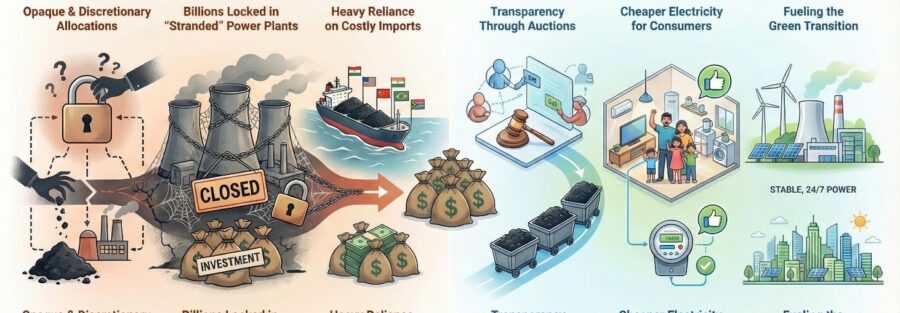
- Transparency: Moving away from discretionary allocations to auction-based systems.
- Affordability: Reducing the “landed cost” of coal to ensure cheaper electricity for the common citizen.
- Support for Stressed Assets: Providing a lifeline to power plants that were sitting idle due to a lack of fuel.
- Energy Security: Optimizing domestic coal usage to reduce the heavy drain on foreign exchange caused by imports.
Evolution: “Two-Window” System
Window I: Notified Price Allocation
Primarily for Government-owned companies (Gencos) and projects with existing Power Purchase Agreements (PPAs). Coal is provided at a “notified price,” ensuring that state-run utilities can keep their costs stable and predictable.
Window II: Premium-Based Auction
This is where the real innovation lies. Under this window:
- Open Access: Any power producer, including private Independent Power Producers (IPPs) and even plants designed for imported coal, can bid.
- No PPA Required: For the first time, plants can secure coal without having a long-term contract to sell power. This allows them to sell electricity on the “Spot Market” or Power Exchanges.
- Flexible Tenure: Linkages can be secured for anywhere from 12 months to 25 years.
The Impact
- Cheaper Electricity
By allowing “Coal Linkage Rationalization”—which essentially means swapping coal sources to the nearest mine—the policy reduces massive transportation costs. These savings are legally mandated to be passed on to the consumers, leading to lower tariffs on your monthly bill.
- Reviving “Stressed” Plants
India has billions of dollars locked in “stranded” power plants that were built but had no coal to burn. The 2025 revisions allow these plants to bid for coal and start generating power, which is crucial for meeting India’s peak summer demands.
- Import Substitution
By making it easier for “Imported Coal-Based” (ICB) plants to access domestic coal, India is drastically reducing its reliance on expensive foreign coal, saving billions in forex reserves.
- Support for Renewable Energy
Interestingly, the Revised SHAKTI Policy 2025 now accommodates Hybrid Plants (RE + Coal). This ensures that when the sun isn’t shining or the wind isn’t blowing, these plants can use coal to maintain a steady flow of “Round-the-Clock” (RTC) power to the grid.