
The Current Crisis (2025-26 Status)
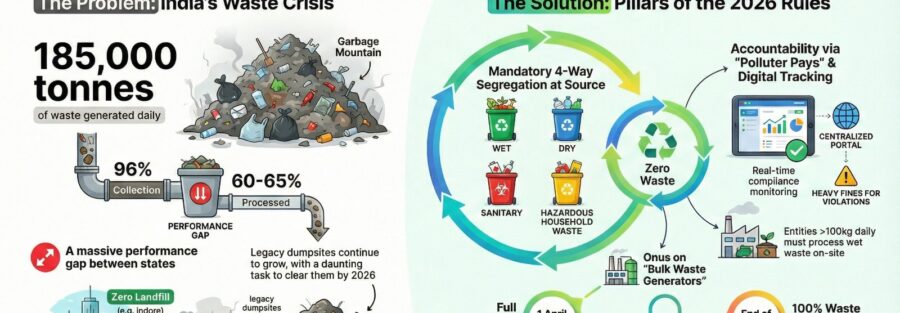
As of early 2026, India generates approximately 1.85 lakh tonnes of solid waste every day. While collection efficiency has soared to nearly 96%, the actual processing/treatment rate still hovers around 60-65%. The remaining waste continues to accumulate in “legacy dumpsites” (garbage mountains) or leaks into water bodies
The Strugglers (Laggards)
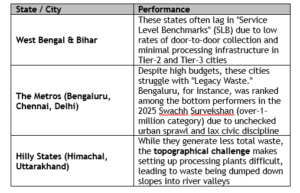
Comparison Across States
Waste management performance in India is highly polarized. Some states have turned waste into a profitable resource, while others struggle with basic collection.
The Leaders (Top Performers)
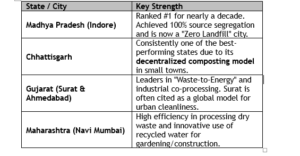
Innovative State Models
- Kerala: Known for its “Green Worm Action Force” (Haritha Karma Sena), which uses a massive network of women’s self-help groups for door-to-door collection.
- Goa: Leads in “Integrated Waste Management” with a centralized state-run corporation that manages waste for all its village panchayats, ensuring no waste reaches its pristine beaches.
Why the 2026 Rules are a “Reset”
The new rules aim to bridge this “State Gap.” By introducing a Centralized Online Portal, the Union Government can now track the laggard states in real-time. If a state fails to clear its legacy waste by the late 2026 deadline, it faces the risk of losing central funding—a move intended to force the bottom-performing states to catch up with leaders like Madhya Pradesh and Chhattisgarh.
Mandatory Four-Way Segregation
The most immediate change for us is how we sort our trash. The 2016 rules mandated three streams; the 2026 rules increase this to four mandatory streams at the source:
- Wet Waste: Kitchen waste, fruit peels, meat, and flowers (to be composted or bio-methanated).
- Dry Waste: Plastic, paper, metal, glass, and wood (to be sent to Material Recovery Facilities for recycling).
- Sanitary Waste: Used diapers, sanitary pads, and tampons (must be securely wrapped and stored separately).
- Special Care Waste: A new category including batteries, bulbs, medicines, and thermometers (to be collected by authorized agencies).
Onus on “Bulk Waste Generators” (BWGs)
The government is placing a massive responsibility on large-scale waste producers, who account for nearly 30% of urban waste.
Bulk Generator, defined as:
- Buildings with a floor area of 20,000 sq. m. or more.
- Entities consuming 40,000 liters of water per day or more.
- Any entity generating 100 kg of waste per day or more.
These entities (including malls, hospitals, and large housing societies) are now required to process wet waste on-site. If they cannot, they must obtain an Extended Bulk Waste Generator Responsibility (EBWGR) certificate to prove their waste was handled professionally.
The “Polluter Pays” Principle
Accountability is the backbone of the 2026 rules. For the first time, environmental compensation will be strictly levied for:
- Operating without registration.
- Providing false data or forged documents.
- Improper waste management practices.
Landfill fees for unsegregated waste will now be significantly higher than the cost of processing it, making dumping the most expensive (and least attractive) option for local bodies.
Tech-Driven Monitoring: The Centralized Portal
To eliminate “paper-only” compliance, the government is launching a Centralized Online Portal.
- All stages—generation, collection, transport, and processing—will be tracked in real-time.
- Bulk generators must register and file annual returns online by June 30 each year.
- Local bodies must map all legacy waste dumpsites (the “garbage mountains”) and provide quarterly updates on their bioremediation progress.
Waste-to-Energy: The RDF Mandate
The rules define Refuse Derived Fuel (RDF)—fuel made from high-calorific non-recyclable waste.
- Industrial units like cement plants and waste-to-energy plants are now mandated to replace a portion of their solid fuel with RDF.
- The substitution rate starts at 5-6% and is mandated to reach 15% within six years.
For State Governments and Urban Local Bodies (ULBs), the Solid Waste Management (SWM) Rules, 2026 represent a shift from being mere “service providers” to “enforcement agencies.”
The 2026 Rules (linked with the SWM Bill 2025), are now binding statutory duties.
- Zero-Dumping Mandate: Municipalities can no longer simply dump mixed waste. They are legally required to ensure that only “inerts” (non-recyclable, non-reactive residues) reach landfills.
- District Oversight: For the first time, District Collectors have been given the direct responsibility of overseeing landfill performance and ensuring municipal compliance.
Fiscal Impact: The “Polluter Pays” for ULBs too
The rules introduce a graded penalty system that affects the municipal treasury:
- Higher Landfill Fees: If a Municipal Corporation sends unsegregated waste to a landfill, they must pay a “Landfill Fee” that is intentionally set higher than the cost of processing that waste. This makes scientific treatment the cheaper option for the city.
- Environmental Compensation (EC): State Pollution Control Boards (SPCBs) are now empowered to levy heavy fines on Municipalities for false reporting, operating without registration, or failing to meet bioremediation targets.
Financial Autonomy: Mandatory User Fees
To reduce the fiscal stress on cities, the 2026 rules provide a legal cushion for ULBs to become self-reliant:
- Compulsory User Fees: Local bodies are empowered (and encouraged) to frame bye-laws to collect user fees from households and commercial units.
- Tourist Taxes: Municipalities in hilly areas and islands can now legally levy user fees on tourists and even regulate the number of visitors based on the city’s waste processing capacity.
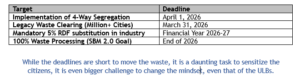
The “Legacy Waste” Countdown
The most daunting task for State Governments is the “Garbage Mountain” deadline.
- Million-Plus Cities: Must complete the bioremediation and biomining of all legacy waste dumpsites by March 2026.
- Other Cities: Must clear their dumpsites by October 2026.
- Quarterly Reporting: States must map every dumpsite and provide geotagged, time-bound progress reports on the Centralized Online Portal. Failure to show progress can lead to the withholding of Central grants.
Land Allocation & Buffer Zones
To solve the “Not In My Backyard” (NIMBY) problem where residents protest new plants:
- Faster Land Allocation: States are mandated to provide land for waste processing facilities within a specified timeframe.
- Buffer Zone Norms: For facilities handling more than 5 tonnes per day, a mandatory “No-Development Buffer Zone” must be maintained. The CPCB will define these zones to prevent residential encroachment near waste plants.
Key Deadlines for Local Bodies