Anchoring the Future: India’s Bold New Shipbuilding Schemes

  • Home
  • Regulatory
  • Anchoring the Future: India’s Bold New Shipbuilding Schemes
Anchoring the Future: India’s Bold New Shipbuilding Schemes

Anchoring the Future: India’s Bold New Shipbuilding Schemes

With nearly 95% of the country’s trade by volume moving through sea routes, India is setting sail toward a massive maritime transformation, on path from a meagre 0.06% global market share to the Top 10 by 2030, a series of powerhouse schemes have been launched.

The Shipbuilding Financial Assistance Scheme (SBFAS)

The cornerstone of India’s strategy is the Shipbuilding Financial Assistance Scheme (SBFAS). Valid until March 2036, this scheme aims to level the playing field against global giants.

  • Graded Subsidies: Depending on the vessel type, shipyards can receive financial aid between 15% and 25% of the contract value.
  • Green Incentives: In a push for sustainability, specialized vessels—such as those powered by hydrogen or hybrid propulsion—receive the highest bracket of support.
  • Ship-Breaking Credit Notes: An innovative feature where owners get a credit note (worth 40% of scrap value) for recycling ships in India, which can then be used to fund new Indian-built vessels.

The Shipbuilding Development Scheme (SbDS)

While SBFAS focuses on the ships, the SbDS focuses on the yards. With an outlay of nearly ₹20,000 crore, it targets:

  • Greenfield Clusters: Developing five “National Mega Shipbuilding Clusters” (like the one in Tamil Nadu) through a 50:50 partnership between the Centre and States.
  • Brownfield Expansion: Providing 25% capital assistance to existing yards for upgrading infrastructure like dry docks

Maritime Development Fund (MDF)

Financing has long been the “anchor” dragging down Indian yards. The ₹25,000 crore Maritime Development Fund acts as a dedicated financial institution. It provides long-term, low-cost capital, allowing Indian shipbuilders to bid aggressively for international contracts.

 India aims to increase its annual shipbuilding capacity to 4.5 million Gross Tonnage (GT) by 2047, creating over 50,000 jobs in the process.

Green Vessel Subsidies: Driving Decarbonization

Under the Shipbuilding Financial Assistance Scheme (SBFAS), “Green” and “Specialized” vessels are now the highest priority. The government has restructured subsidies to favor high-tech, eco-friendly ships.

  • Financial Assistance Rates:  Specialized/Green Vessels: These receive a subsidy of 15% on the first ₹100 crore of the contract value and a significantly higher 25% on the remaining amount.
    • Qualifying Technologies: To qualify as “Green,” vessels must utilize propulsion systems like Hydrogen Fuel Cells, Electric/Hybrid engines, or Methanol/Ammonia-ready dual-fuel systems.

Green Vessel Subsidies: Driving Decarbonization

Under the Shipbuilding Financial Assistance Scheme (SBFAS), “Green” and “Specialized” vessels are now the highest priority. The government has restructured subsidies to favor high-tech, eco-friendly ships.

  • Financial Assistance Rates:  Specialized/Green Vessels: These receive a subsidy of 15% on the first ₹100 crore of the contract value and a significantly higher 25% on the remaining amount.
    • Qualifying Technologies: To qualify as “Green,” vessels must utilize propulsion systems like Hydrogen Fuel Cells, Electric/Hybrid engines, or Methanol/Ammonia-ready dual-fuel systems.
  • The “Domestic Content” Rule: To claim these subsidies, ships must meet strict “Make in India” benchmarks for materials. At least 50% of the value of the vessel (excluding specialized machinery not yet made in India) must be indigenous.
  • Milestone-Based Payouts: Unlike older policies that paid only at the end, the new SBFAS releases funds in three stages:
    1. 30% at Keel Laying.
    2. 40% at Hull Launching.
    3. 30% upon Final Delivery.

National Mega Shipbuilding Clusters

The government towards “Integrated Clusters”—massive 2,000-acre zones that house shipyards, equipment manufacturers, and design centers in one plug-and-play ecosystem.

The Five Primary Greenfield Locations:
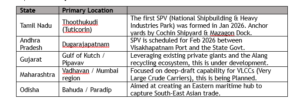
Brownfield Expansions (Upgrading Existing Hubs):

In addition to the greenfield sites, massive capital injections are being funneled into:

  • Kandla & Vadinar (Gujarat): Upgrading for large vessel ship repair.
  • Kochi (Kerala): Specifically for specialized “Green” vessel fabrication blocks.

The “Shipbreaking Credit Note” Bonus
There is a unique circular economy incentive for Indian cos.: