
India is currently navigating one of the most significant demographic shifts in human history. With an urban population expected to reach 600 million by 2030, the country’s “engine of growth” is running on a critically low tank of water. As of 2024, NITI Aayog reports that nearly 21 Indian cities are on the verge of running out of groundwater, a crisis exacerbated by the fact that India possesses only 4% of the world’s renewable water resources despite housing 18% of the global population.
“Wastewater” is a term we can no longer afford to use, rather, should be termed as “used water”—a massive, untapped reservoir that, if managed properly, could solve the urban water deficit.
The Indian Urban Reality: Statistics of the Flow
Indian cities generate approximately 72,368 million liters per day (MLD) of sewage (CPCB). However, the installed treatment capacity stands at only about 31,841 MLD (roughly 44%). Even more concerning is that the actual utilization of these plants is often lower, and the amount of water effectively recycled for reuse is a mere fraction of that total.
This gap results in billions of liters of untreated waste entering our river systems daily, creating a double-edged crisis: environmental degradation and wasted resource potential.
Nagpur: The Blueprint for Industrial Symbiosis
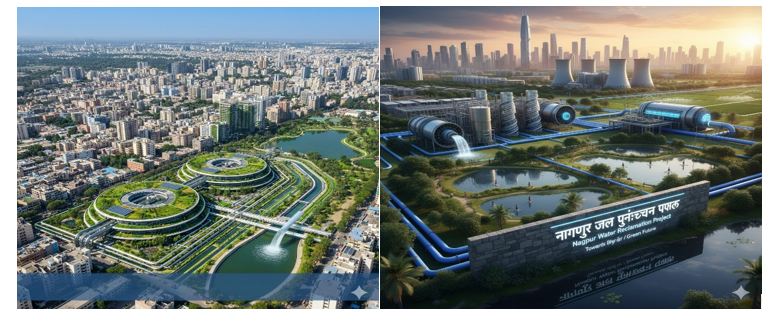
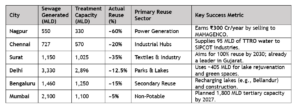
Nagpur, the “Orange City” of Maharashtra, has emerged as a success story in proving that wastewater is a financial and environmental asset. Nagpur was the first city in India to implement a large-scale model of selling treated sewage to thermal power plants.
Under this arrangement, the Nagpur Municipal Corporation (NMC) treats its sewage to a secondary level and pipes it to the Mahagenco power plant.
- The Impact: By using over 190 MLD of treated sewage for cooling and industrial processes, the power plant saves an equivalent amount of fresh water from the Totladoh dam.
- The Revenue: The city generates nearly INR 15–20 crore annually in revenue from selling this water, which is then reinvested into urban infrastructure.
This “circular economy” model is now being adopted in other metros as well, like for eg. In Chennai, a city that famously reached “Day Zero” in 2019, the Metropolitan Water Supply and Sewerage Board (CMWSSB) has commissioned two 45 MLD Tertiary Treatment Reverse Osmosis (TTRO) plants. These plants supply high-quality reclaimed water to industrial hubs in Sriperumbudur and Oragadam, reducing the industrial draw on the city’s drinking water reservoirs.
Urban Water Reuse Comparison (2025 Estimates)
Global Best Practices: Scaling the Vision
To move from industrial reuse to total urban water independence, India can look toward international benchmarks where technology meets public policy.
Singapore: The Gold Standard of “NEWater”
Singapore’s Public Utilities Board (PUB) has turned a vulnerability into a strength. Their NEWater program provides high-grade reclaimed water produced from treated used water that is further purified using advanced dual-membrane (microfiltration and reverse osmosis) and ultraviolet disinfection.
- The Stat: NEWater currently meets 40% of Singapore’s total water demand, a figure expected to rise to 55% by 2060.
- Public Trust: Singapore overcame the “yuck factor” by bottling NEWater and having leaders drink it on national television, proving that water should be judged by its quality, not its history.
- Israel: Agricultural Dominance
Israel holds the world record for wastewater reclamation.
- The Stat: Israel treats and reuses nearly 90% of its wastewater, primarily for irrigation. This provides roughly 25% of the country’s total water supply.
- The Technology: The Shafdan project uses Soil Aquifer Treatment (SAT), where treated effluent is spread on sand fields and allowed to percolate into the ground, using the earth as a natural filter before being pumped out for crops.
The Roadmap for a Water-Secure Urban India
For Indian cities, to achieve sustainability, a four-pillar strategy is required:
- Mandatory Dual Piping: New high-rise developments must be mandated to have dual-piping systems—one for potable water and a second for reclaimed water to be used in flushing and landscaping.
- Decentralized STPs: Moving away from massive, centralized plants to smaller, community-level Sewage Treatment Plants (STPs) reduces the cost of pumping water across vast distances.
- Financial Incentives: Governments should offer “Water Credits” or tax rebates to industries that achieve zero liquid discharge (ZLD) or use 100% recycled water.
- Standardization: The Ministry of Jal Shakti needs to enforce uniform standards for “Class A” reclaimed water to ensure it is safe for non-potable urban contact, such as in public parks and construction.
The 2025-2027 Mandate
The Central Government’s latest “Safe Reuse and Management of Treated Wastewater” framework has set a mandatory target for all Class-I cities (population >100,000) to reuse at least 20% of their water consumption by 2025-26.
With the Jal Jeevan Mission (Urban) aiming to provide universal water supply, the reclamation of wastewater is no longer optional, but a compulsion. If we can treat even 50% of the 72,000 MLD we generate daily, we would add a “virtual river” to our country that never runs dry. By following Nagpur’s pragmatism, Singapore’s and Israel’s technology, India’s urban centers can ensure that the tap never runs dry for the next generation.