
Riding the Wave: Breaking Down India’s Draft National Water Metro Policy 2026
Urban commuting in India is on the verge of a major transformation. The Ministry of Ports, Shipping & Waterways (MoPSW) circulated the Draft National Water Metro Policy, an ambitious blueprint aiming to introduce electric and hybrid mass transit across our inland waterways.
Vision, timeline and tenure
The policy maps out a phased rollout targeting 18 cities. Phase I prioritizes major urban and religious centers like Guwahati, Srinagar, Patna, Varanasi, Ayodhya, and Prayagraj. Phase II will extend the network to cities like Tezpur and Dibrugarh.
Instead of traditional, highly polluting diesel ferries, the Water Metro will operate like a rapid transit system. Expect automated fare gates, digital ticketing, modern floating jetties, and fixed schedules seamlessly integrated with existing land-based bus and metro networks.
Budgetary Allocation and Timeline
- The Outlay: The Central Government has framed a ₹9,280 crore budget outlay. This covers the Centre’s 50% share of the estimated ₹18,594 crore total capital expenditure required across the target cities.
- Tenure: The operational tenure of the scheme is structurally scheduled over a 10-year window, allowing funding tranches and phase rollouts to scale systematically.
Institutional Framework & Execution Model
The current draft clarifies the division of responsibility between federal and state bodies to prevent jurisdictional friction:- Nodal Approving Body: The Ministry of Ports, Shipping and Waterways (MoPSW) serves as the primary approving authority.
- Technical Nodal Agency: The Inland Waterways Authority of India (IWAI) will act as the technical backbone for projects situated on designated National Waterways. IWAI is responsible for standardizing safety codes, setting vessel dimensions, and guiding state governments.
- State & Local Mandate: Projects will be executed via city-level Special Purpose Vehicles (SPVs) formed jointly by the Centre and States. State governments are mandated to provide land free of cost and assume financial and execution responsibility for enabling works—including initial channel dredging, creating access roads, and providing Viability Gap Funding (VGF) if operations run deficits.
- Harit Nauka Compliance: Aligned with India’s green transition targets, the policy mandates electric, battery-operated, solar-assisted, or hybrid propulsion technologies to keep emissions near zero
Pros & Challenges:
- Capital-Light Infrastructure: Unlike traditional rail metros that require massive land acquisition, tunneling, and overhead civil construction, a Water Metro utilizes existing natural waterways. This drastically reduces the capital required per kilometer.
- De-congesting Urban Grids: By opening up a parallel transit corridor on the water, cities can shift thousands of daily commuters off oversaturated road networks.
- Low-Carbon Mobility: Mandating electric, hybrid, and solar-assisted ferries drives green shipping and directly curbs urban emissions.
- Climate Resilience: Amphibious and hybrid vessels remain functional during heavy monsoons and urban flooding, ensuring remote or water-locked populations stay connected when roads fail.
The Challenges
- Seasonal Navigability: India’s rivers are highly seasonal. Maintaining adequate drafts (water depth) during peak summer months requires consistent and expensive dredging.
- Last-Mile Connectivity: A water metro is only as effective as the transport waiting at the jetty. Poor integration with local buses or auto-rickshaws can easily deter daily commuters.
- High Upfront Fleet Costs: While infrastructure costs are lower, acquiring state-of-the-art battery-electric ferries and setting up high-capacity charging grids at jetties is capital-intensive.
- Ecological Disruption: Increased vessel traffic, dredging, and infrastructure development could disturb sensitive aquatic ecosystems if not strictly regulated.
18 cities with a population exceeding one million or critical geography have been cleared for water metro development. Individual city deployments are estimated to cost between ₹800 crore and ₹1,300 crore each.
- Phase I (Priority Urban & Religious-Tourism Hubs): Guwahati, Srinagar, Patna, Varanasi, Ayodhya, and Prayagraj.
- Phase II (Industrial & Regional Hubs): Extending infrastructure to key regional river towns such as Tezpur and Dibrugarh in Assam.
@aXYKno is engaged for Feasibility and Transaction Support of the Mangaluru Water Metro Project in Gurupura – Netravathi Rivers of Mangaluru initiated by the Karnataka Maritime Board.
Financing the Fleet
The draft policy leans on three main pillars:
- Public-Private Partnerships (PPP): The government encourages private sector involvement in terminal development, fleet operations, and ticketing systems.
- Non-Fare Revenues: Similar to airports and rail stations, terminals will generate income through commercial real estate, waterfront tourism packages, advertising spaces and other monetization strategies.
- Indigenous Subsidies: By promoting local shipbuilding under the #AatmanirbharBharat initiative, the government aims to lower vessel procurement costs and access manufacturing-linked financial incentives.
Caselets
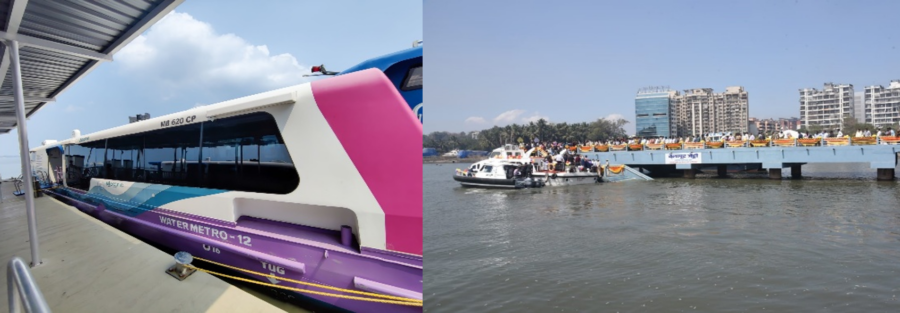
Kochi Water Metro & Nerul Water Taxi Jetty: Unlike other water transport experiments that failed to attract daily commuters, Kochi Water Metro hit massive milestones quickly. High Ridership & Public Patronage. Seamless Multimodal Integration apart from financial structuring can be attributed as key to success.
Kochi Water Metro is built on an Indo-German financial cooperation framework. The total project cost stands at approximately ₹1,137 crore. KfW provided a long-term soft loan ranging between EUR 85 million and EUR 110 million (covering over 70% of the project’s capital requirements). The asset is owned and managed by Kochi Water Metro Limited (KWML), which operates under a unique public corporate structure: Government of Kerala (GoK): Holds a dominant 74% equity stake while Kochi Metro Rail Limited (KMRL): Holds a 26% equity stake. While the external German loan paid for the boats and technical components, international loans typically cannot be used to purchase land. Therefore, the Government of Kerala directly financed 100% of the land acquisition costs, local state taxes, and administrative overheads out of the state budget to ensure zero project delays.
Kochi’s financial success stems from utilizing low-interest, long-term international green financing to offset heavy initial technical CapEx, while the local government cleared the path by taking full responsibility for land and local equity.
On the other side, Nerul Water Taxi Jetty (Navi Mumbai) ended up as the Challenged Project.
Despite a massive ₹148 crore infrastructure investment, the Nerul water transport terminal became a cautionary tale. The project suffered from a lack of integration and flawed pricing strategies. Exorbitant initial tariffs alienated everyday commuters, keeping the service from achieving viable daily ridership. Additionally, severe environmental friction arose when construction allegedly blocked local tidal flows, drawing heavy pushback from environmental watchdogs and legal bodies over Coastal Regulation Zone (CRZ) compliances.