
What is CBAM?
The European Union (EU) has announced the implementation of its Carbon Border Adjustment Mechanism (CBAM), set to begin its transitional phase in October 2023. This mechanism introduces a carbon tax on imports of goods produced through non-sustainable or high-emission processes.
Starting 1st January 2026, CBAM will impose a carbon levy of 20–35% on select imported products (such as Iron, Steel and aluminum products etc.).
The primary goal of this policy tool is to reduce global carbon emissions by ensuring that imports face the same carbon costs as EU-manufactured goods.
CBAM is designed to prevent carbon leakage, uphold the EU’s climate goals, and promote a global shift toward cleaner, more sustainable production practices.
How can it Impact India particularly in Steel Sector?
Steel is among the most energy- and emissions-intensive industrial sectors. In 2019, direct carbon dioxide (CO₂) emissions from steelmaking accounted for approximately 7% of global CO₂ emissions.
India, currently the second-largest producer of crude steel in the world, is projected to account for nearly 20% of global steel production by 2050 (IEA, 2020). It has also emerged as the second-largest consumer of finished steel globally. However, the emission intensity of steel production in India—estimated at 2.54 tonnes of CO₂ per tonne of crude steel (tCO₂/tcs)—remains significantly higher than the global average of 1.85 tCO₂/tcs (Ministry of Steel, 2024).
India’s steel industry is broadly categorized into primary and secondary sectors based on the production technology employed.
Primary steel is mainly produced via the blast furnace–basic oxygen furnace (BF–BOF) route and is dominated by Integrated Steel Producers (ISPs)—typically large, vertically integrated companies.
Secondary steel, in contrast, is produced using direct reduced iron (DRI) in combination with either electric arc furnaces (EAF) or induction furnaces (IF). This segment is primarily composed of micro, small, and medium enterprises (MSMEs) that rely on scrap or DRI-based inputs.
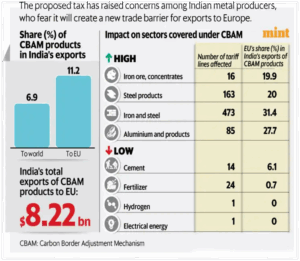
The introduction of the Carbon Border Adjustment Mechanism (CBAM) by the European Union is expected to influence the decarbonisation trajectory of India’s steel sector. For large producers, the degree of impact will depend on their current positioning, readiness, and the strategies they adopt to transition toward cleaner production methods.
However, smaller players, particularly those integrated into global supply chains and indirectly exposed to CBAM, are far more vulnerable. With ongoing financial constraints, limited technological capabilities, and capacity bottlenecks, these enterprises may struggle to comply with the rising demands of a low-carbon global marketplace
.
Key Challenges to Decarbonising India’s Steel Sector
- Raw Material Constraints:
India relies on the BF–BOF route, which requires coking coal and iron ore. While iron ore is abundant, coking coal is limited and low-grade, leading to higher material and energy use. - Scrap Shortage:
Steel scrap, crucial for secondary steelmaking and EAF operations, remains scarce, limiting low-emission production pathways. - Technological Limitations:
Advanced solutions like hydrogen-based reduction and CCUS are still not commercially viable, delaying deep decarbonisation. - Financial Barriers:
With thin profit margins and high upfront costs, steelmakers face difficulty investing in clean technologies despite global pressure.
The Carbon Border Adjustment Mechanism (CBAM) has faced criticism from several of the EU’s trading partners, particularly from the Global South, including India. Key concerns include:
- its unilateral implementation,
- perceptions of protectionism disguised as climate action,
- the lack of clear evidence on its actual environmental effectiveness,
- potential conflicts with international trade laws, and
- the negative implications for trade, livelihoods, and equity in developing economies.
What Can Indian Govt. may do to Mitigate the Impact of CBAM?
Indian Govt. may adopt a multi-pronged approach to reduce its vulnerability to the EU’s Carbon Border Adjustment Mechanism (CBAM):
Align Domestic Policies with Carbon Efficiency Goals:
While initiatives like the National Steel Policy (NSP) 2017 and the Production Linked Incentive (PLI) scheme aim to boost production capacity, they currently lack a focus on carbon efficiency. These policies can be complemented by incorporating incentives for cleaner technologies and sustainable production practices.
Carbon Price Recognition:
India can engage with the EU to seek recognition of its domestic energy taxes as an equivalent to a carbon price. This could help reduce the CBAM burden on Indian exports by acknowledging existing efforts to internalize carbon costs.
Technology Transfer and Climate Finance:
India should advocate for technology transfer and financial support mechanisms from the EU and other developed nations. This would aid in the decarbonisation of India’s industrial sector, particularly in steel, without compromising on economic growth.
Green Industrial Transition for Net Zero 2070:
To meet its Net Zero target by 2070 while sustaining economic and developmental goals, India must strategically invest in green manufacturing. Enhancing carbon efficiency will not only help in achieving climate commitments but also ensure global competitiveness in a carbon-conscious trade landscape.
In contrast, MSMEs—if directly or indirectly impacted through supply chains due to EU trade —are highly vulnerable, given their limited readiness in terms of technology, knowledge, finance, and capacity. Without targeted support, they are unlikely to transition effectively toward low-carbon production. To address this, Indian Govt. may negotiate with EU could consider a longer transition period for MSMEs and provide support in the form of finance, technology transfer, and capacity building. At a minimum, the revenue generated from CBAM could be recycled back to affected countries in the Global South including India, aligning with the EU’s stated goal of promoting decarbonisation in its trading partners.