
#Startup #Ecosystem in #India, and the way forward –
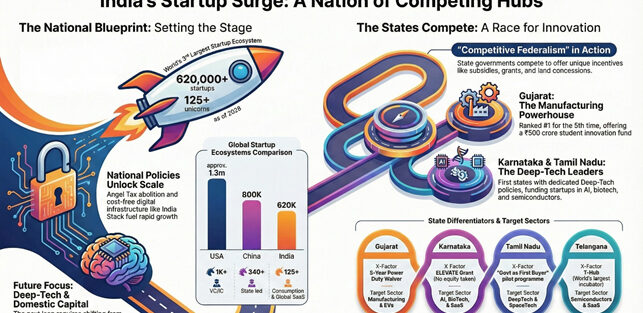
While #India positions as the world’s third-largest ecosystem, has registered less than a half of that of #USA.
Global Startup Snapshot: 2026 Comparison
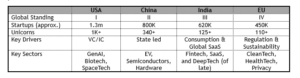
Silicon Valley/US leads the #startups race and remains the hub for global innovation esp. Agentic AI and Bio-convergence, due to their access to late-stage funding and a culture that celebrates “failed” founders. UK (London)/EU remains the region’s heavyweight, especially in Fintech. While the Chinese leads the world in Manufacturing Innovation with its unmatched Supply Chain, India has transitioned from being the “back office” to the “product office” of the world with the abolition of Angel Tax in 2024 and a surge in domestic capital participation. India Stack (UPI, ONDC, Health Stack) provides a digital public infrastructure that allows startups to scale to millions of users at near-zero cost.
The following table highlights the core differences between the four major startup powerhouses.
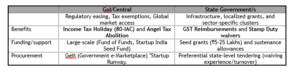
India’s startup ecosystem operates under a “Competitive Federalism” model. While the Government of India (GoI) provides the macro-regulatory framework and major tax reliefs, State Governments compete to offer localized incentives like power subsidies, land concessions, and sector-specific grants.
Central vs. State, a comparative
State-wise Comparative Analysis (2026 Rankings)
The DPIIT evaluates states across seven reform areas, including institutional support, funding, and mentorship. DPIIT States’ Startup Ranking 5.0, released in Jan 2026, states are categorized based on their ecosystem maturity.
The “Best Performers”: Gujarat & Goa – Gujarat: Ranked #1 for the 5th consecutive time. Its SSIP 2.0 (Student Startup & Innovation Policy) provides a massive ₹500 crore fund specifically for university-level innovators. Offers up to 25% capital subsidy for manufacturing startups, making it the preferred hub for hardware and EV startups.
“DeepTech Leaders”: Karnataka & Tamil Nadu – Karnataka (Startup Policy 2025–2030): With an outlay of ₹518 Crore, it is shifting focus from “Apps” to “DeepTech” (AI, Quantum Computing, and SpaceTech). Tamil Nadu (Deep-Tech Policy 2026): TN became the first state to launch a dedicated Deep-Tech Policy. ₹100 crore dedicated fund for 100 high-end research startups (Semiconductors, Biotech).
The “Academic Hubs”: Delhi & Uttar Pradesh – Delhi (2026 Policy): Focuses on “Academic Incubation,” turning government campuses (DTU, NSUT) into startup cradles with milestone-based funding, while Uttar Pradesh uses its massive ₹1,000 Crore Fund of Funds to encourage startups in Tier-2/3 cities, offering additional 50% incentives for women-led
A Comparative of Key State Policies

The way forward –
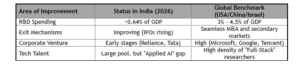
#India needs to build a mature, self-sustaining ecosystem that prioritizes deep-tech, regional inclusion, and domestic capital. Despite being the world’s 3rd largest ecosystem, structural gaps remain.
What’s Missing vs. Global Peers
Mobilizing Domestic “Risk Capital”
India is currently over-dependent on foreign Venture Capital (VC), which makes the ecosystem vulnerable to global macro-shocks. Creation of Liquid Pool, FoF and tap the Pension Funds and Insurance cos.
Transitioning to “Deep-Tech” & IP-Led Growth
Most Indian startups are currently in “Services” or “Consumer-Tech” (Fintech, Edtech). To be a global leader, India needs more IP (Intellectual Property) owners. National Deep Tech Startup Policy could be a solution that accepts 7–10 year gestation periods for chips, biotech, and space-tech. Create “Lab-to-Market” pipelines.
Strengthening “Public Procurement” (Govt as Buyer)
Government is the largest customer. As the “First Buyer”, government should compulsorily procure from startups in defense, healthcare, and green energy. Other sectors should also be earmarked for quota. Though under General Financial Rules (GFR) Rule 170 and 173, all Central Ministries and Public Sector Undertakings (PSUs) are mandated to relax the following criteria for DPIIT-recognized startups, this needs to be tracked.
Bridging the Infrastructure Gap – Build Sector-Specific Regional Clusters rather than generic incubators
Regulatory “Safe Harbors” & Exit Ease
Founder friction is often highest during “Exit” or “Failure.” Streamline the Fast-Track Exit process under the Insolvency and Bankruptcy Code (IBC) so founders can “fail fast” and start again without 3–5 years of legal baggage.