
#India has passed the #Sustainable #Harnessing and Advancement of Nuclear Energy for Transforming India #SHANTI Bill, 2025, repealing the Atomic Energy Act of 1962 and the Civil Liability for Nuclear Damage Act (CLNDA) of 2010.
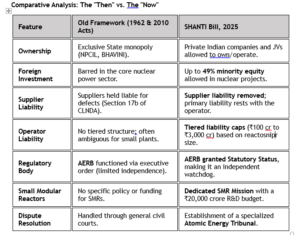
SHANTI breaks this “nuclear glass ceiling” the exclusive domain of the Nuclear Power Corporation of India Limited #NPCIL till now, by allowing private Indian companies to build, own, and operate nuclear power plants.
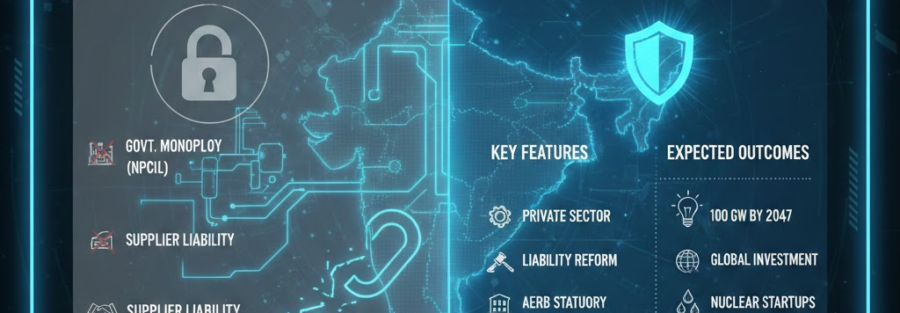
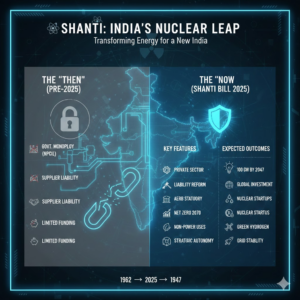
Key Features
- Private Sector Participation: Indian-incorporated companies and joint ventures can apply for licenses to operate nuclear reactors.
- Liability Reform: Caps the operator’s liability (ranging from ₹100 crore to ₹3,000 crore based on capacity) and removes the “right of recourse” against suppliers for equipment defects.
- Statutory Status for AERB: The Atomic Energy Regulatory Board (AERB) will now have statutory status, making it a more independent and powerful watchdog for nuclear safety.
- Nuclear Tribunal: A specialized tribunal will be established to handle disputes and compensation claims, ensuring faster legal resolution.
- Focus on SMRs: The program emphasizes Small Modular Reactors (SMRs), with a dedicated ₹20,000 crore mission to develop indigenous “Bharat SMRs” that are easier to deploy and finance than mega-reactors.
#Nuclear energy contributes only about 3% of India’s total electricity generation, with an installed capacity of roughly 8.8 GW.
Present Bottlenecks:
- Capital Intensive: Building a nuclear plant is incredibly expensive.
- The Liability Deadlock: International suppliers hesitant to enter the Indian market because the 2010 law held them liable for accidents even years after construction.
- Energy Hunger: With the rise of #AI, massive #data centers, and #MakeinIndia push, India needs a 24/7 “base-load” power source that isn’t coal. Objectives: 100 GW by 2047
#SHANTI ‘s ambitious roadmap:
- Capacity Expansion: The primary goal is to reach 100 GW of nuclear capacity by the year 2047.
- Net Zero 2070: Nuclear is India’s commitment to achieving #NetZero #carbon #emissions by 2070.
- Non-Power Applications: Beyond electricity, SHANTI seeks to expand nuclear #technology in healthcare (cancer care), agriculture (food irradiation), and water desalination.
- Strategic Autonomy: By opening up the sector, India aims to foster a domestic “nuclear industrial complex,” reducing reliance on imported technology over time.
Expectations:
Global Investment
The Rise of “Nuclearpreneurs”
Flip side – Safety and Accountability
Diluted Liability: Argument like capping liability and shielding suppliers.
Waste Management: While the government retains control over spent fuel, the sheer volume of waste from a 100 GW program will require a massive upgrade in long-term storage solutions.